
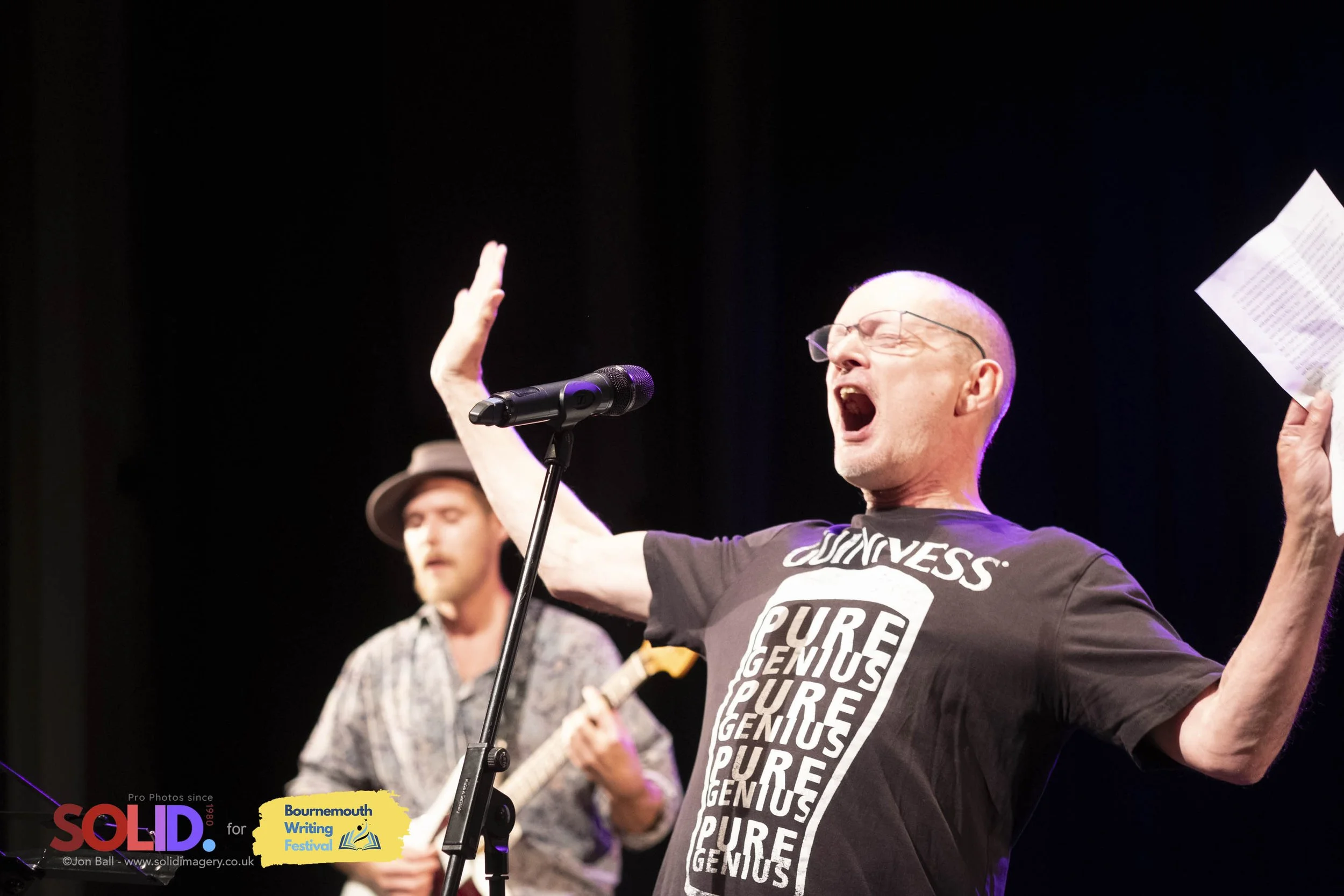
Above: David performing his prize-winning poems, accompanied by a live band, at Bourn Jammy on the main stage at Pavilion Dance, Bournemouth (during the Bournemouth Writing Festival) in April 2024.
Below: the Dithering Chaps duo performing from David’s poem ‘Carbon Clumps’ at the launch of Long Poem Magazine 33 at the Barbican Library in June 2025.
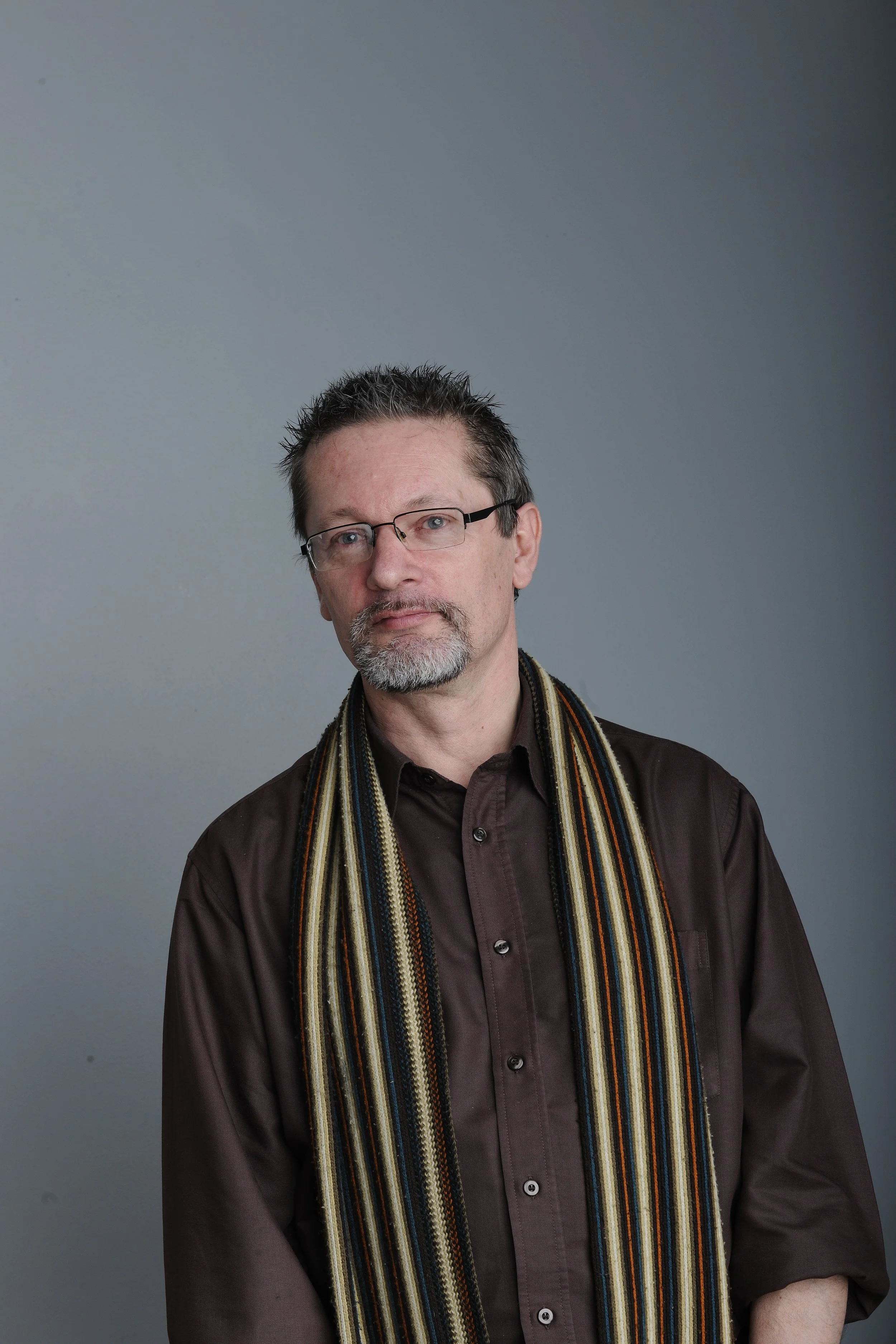
D G Herring
David Herring is the Lead Editor and driving force behind Dithering Chaps. His alter ego is the poet, D G Herring, who we showcase here.
David’s work has recently appeared in a variety of literary magazines, including; South Poetry Magazine, New Isles Press, Poetry Salzburg Review, Stand, Orbis and Long Poem Magazine. He has a poem forthcoming in Dreamcatcher and was published recently in Acumen 113. His poem, The deal with Alcestis, will appear in The Havisham Steps: Modern Gothic Poetry, part of The Broken Spine’s Slimlines series.
David feels that his extensive experience of submitting poems for publication (along with his almost equally extensive collection of rejection emails!) means he understands what the process is like from a poet’s point of view. Dithering Chaps try very hard not to be ‘up ourselves’ as editors - we treat all submissions just as we hope our own are being treated. (And that’s why we go the extra mile, for example, by providing positive written feedback on all your submissions.)
During lockdown, David’s work was published on Patreon and, in an innovative arrangement with The Literary Consultancy, he received monthly online feedback from Ahren Warner – see the TLC blog dated October 1st, 2020 ("Putting it out there").
David’s ‘epic’ poem, The Sheliand, was Dithering Chaps’ first publication - we took this on as a guinea-pig project to see what the publishing process involved. We learned a lot and our publications benefited greatly from this trial run!
David’s latest work is ‘Brix: deconstructing the wall’ and he is currently seeking agency representation for this longform poem. We wish him luck!!
Publisher: Dithering Chaps
Format: Poetry chapbook
Length: 46 pages
Publication date: March 2023
ISBN: 978-0-09574538-2-1

Scroll down to find information and notes on the work, its author and the inspirations behind this extraordinary and inspiring journey of transition.
The Sheliand was reviewed in South 68 by Greg Freeman, as follows …
This pamphlet, which has helpful notes at the back, does require some explanation. It is a single poem that re-imagines the Gospel stories, and at the same time traces the transition journey of its hero(ine) Xe (prounounced ‘zee’) from male-to-female. It loosely combines features of Germanic and Saxon verse forms. This reflects the fact that it owes a debt to a translation of The Heliand by G. Ronald Murphy, an epic poem in Old Saxon, written in the first half of the 9th century.
In this radically updated version the male-to-female protagonist acquires followers and tabs of oestrogen pills, and attracts the attentions of paparazzi and courts. Its language is comic –
“Not parthenogenesis, perhaps, but genesis is genius”
- irreverent, and often extremely colourful, if not offensive, to some, at any rate. That may be the poet’s point. (“Anti-Christian, of course, but I’m not anti-Christ”). His message is: “LGBT + means us.”
It’s easy to see that the poet had a lot of fun composing “this marriage of Venus and Mars”. I found myself admiring the effort, enthusiasm and indeed linguistic skill involved in the exercise, but scratching my head at the same time.
Greg Freeman
What is The Sheliand?
‘The Sheliand’ is a poem that re-imagines the Gospel stories in a thoroughly secular and overtly subversive way.
Its hero(ine) is Xe (pronounced ‘zee’) whose journey through a male-to-female transition is traced in this poem. Along the way, Xe acquires followers and tabs of oestrogen pills, while sharing worldly wisdom about
how to live. Finally, prepped for gender-reassignment surgery, Xe attracts the attention of both paparazzi and courts.
But will there be a happy ending for Xe?
Author’s note on the title and structure of The Sheliand
The title of the poem is itself a form of transition – from Heliand to Sheliand
In the ninth century, Christian Saxons returned to the land of their still-pagan forebears in Germany, armed with a version of the Gospels set in the world of mead-halls and hill-forts...
Their aim? To convert proud Shield-folk who still worshipped a sacred pillar linking earth and sky by offering their own more powerful magic: their Christian Saviour.
They succeeded.
The book they took with them was ‘The Heliand’ (‘Saviour’) and, through it, the Christians, both metaphorically and literally, cut down the sacred pillars and shrines of the pagans and brought them into the patriarchal folds of the new faith.
The aim of ‘The Sheliand’? To restore the balance between sky-god and earth-goddess by re-telling the story through the eyes of its LGBT protagonist, Xe. Xe’s humanity, full of worldly wisdom and spiritual transcendence, is expressed through a male-to-female transition: He-to-She resolved in the gender-neutral pronoun, Xe.
The idea for the symmetries in my poem came from theories concerning the structure of the Heliand itself. One compelling account shows how the transfiguration scene is the structural centre of that poem around which thematically-paired fitts (or verses) are arranged eg the Annunciation/the angel announces Christ’s death to Mary; Sermon of the Mount/Peter’s defence of Christ on the Mount of Olives; Death of John the Baptist/Death of Jesus foretold.
My poem is conceived of in the same way.
Apart from the two End-poems, I found that mirror reversals or echoes of earlier fitts placed themselves equi-distantly on either side of my transfiguration/transitioning scene.
I imagined arranging my fitts page by page to form the shape of a Cross, but, if you try it, you’ll find it doesn’t quite work. In fact, it seems to lend itself better to the Plus symbol (with Fitt XVII at the centre and four projecting arms of eight fitts). And perhaps that is fitting. I’ve always been uncomfortable with a religion at whose iconic heart is such a symbol of pain and suffering – the Cross.
The Plus, on the other hand, is positivity itself!
Author’s note on versification in The Sheliand
I have loosely combined features of Germanic and Saxon verse forms to create my version of a “fitt” (from the German ‘fitten’ meaning episodes or divisions).
The basic line has four dynamic stresses, the first three of which alliterate, as for example – “Word is a window on why things began” or “Mary from Magdala, marry me now.”
My Saxon models showed a fair amount of leeway in how other, non-stressed, syllables are packed around the four main stresses. An “ideal” line might have eight syllables only as in Dum-ti Dum-ti Dum-ti Hump-ti. However, many Saxon lines throw in bonus syllables before some or all of the stressed ones (in prosody, this is referred to as anacrusis). An example from the Sheliand would be: “Mastering the meme machine of this Me!Me! generation.” In fact, the majority of my lines take this form.
Like my Saxon models, I also have lines with alliteration on non-stresssed syllables and occasionally make do with less than three alliterations!
I adopt a “bob and wheel” style ending (with end-rhymes ababa) in the last five lines of each fitt. I borrowed this technique from Sir Gawain and the Green Knight. This device is not to be found in the Heliand.
I also incorporate an ABCB end-rhyme pattern into each of the three quatrains of my fitts. This is not very Saxon, rhyme being more the province of Latin hymns of the period.
I hope my flexible and idiosyncratic approach, yielding a standard 17-line fitt has something to commend it. However, if my poem bends your ear out of shape, please blame the lack of craft on this poor poet’s pen and not the quills of his Saxon forebears.
Parallels
The author has prepared two maps to help navigate his poem.
The first (left) shows Xe’s travels in the West Country - the setting of The Sheliand. Roman numerals indicate the ‘fitt’ (verse) where events take place.
The second (right) is a map of Israel at the time of the Gospels and shows where events re-imagined in The Sheliand are thought to have taken place.

Concordance with the New Testament and other sources
-
The two ‘End-Poems’ top and tail ‘The Sheliand’, with nods to the Anglo-Saxon world in which the original ‘The Heliand’ was written, and highlight what the author takes to be the latter’s subversive intent ie ‘The Heliand ‘places the Christian Gospel stories in a feudal setting all the better to convert its pagan listeners. (For a more nuanced interpretation, see Murphy [ The Heliand: The Saxon Gospel OUP 1992, page 46] who writes movingly about how Anglo-Saxon Christian authors and artists sought to organically unite Germanic and Christian stories in a radically inclusive way.) First quatrain ‘The Heliand’ styles itself as ‘berehtlico an buok’ which the Murphy translation renders as ‘bright-shining book.’ He notes this use of ‘bright’ was attractive to pagan Germans who saw light as a conduit to their gods. He suggests it might also refer to the illuminated style of Bible of the day; ‘mead-room’ is used, rather than the more usual mead-hall, following Fitt 3 of the original ‘The Heliand’ which has ‘uiinseli’ = ‘wine’ (mead) ‘room’ (salle); the reference to ‘meadow’ echos ‘The Heliand’’s own frequent references to the ‘meadows of Heaven’. Second quatrain the church is the Bride, Christ the Bridegroom in Christian exegesis; Third quatrain the ‘pillar of wood’ is a form of shrine in use by Germanic pagans; one of the Christian approaches to conversion was to cut down such pagan symbols.
-
First quatrain The author hopes this move is familiar to lovers of Monty Python’s ‘Life of Brian’ – ie to provide the necessary distance that indicates that ‘The Sheliand’ is not about the New Testament Christ; in fact, readers should take Fitts I and II to refer to the Gospel Christ, whereas from Fitt III onwards we enter the world of Xe; ‘tossed before swine’ cf Matthew 7:6; Third quatrain ‘stealing sacrals’, in a word, ‘sacrilegious’ – itself from the Latin to ‘steal the sacred’; ‘Heliand’ = ‘saving’/’healing’ ie ‘Saviour’; ‘a-versio’ means ‘to turn away’ from – ‘con-versio’ ‘to turn towards’ - ideas that originate for the author in Saint Augustine; Bob and wheel here, steals the sacred from Dante’s topos of boats in dangerous waters which occurs and recurs in the ‘Commedia’ - the primary reference is to Paradiso Canto 2: 1-6.
-
This fitt is a nod to Genesis (of both world and poetry alike) and should also be considered to be part of the ‘Life of Brian’ strategy referred to above ie the Christ described in this case is modelled on Gospel accounts so as to distance Him from ‘The Sheliand’ whose protagonist is about to be introduced; First quatrain condenses ideas from Descartes’ ‘cogito’ (ergo the sum in consummate!); plus Dante’s description of metaphor in Convivio as “verità nascose sotto belle menzogne” (ie ‘consummate lies’); plus Terence Mckenna’s descriptions of magic mushrooms’ capacity to make the world of words bring forth the physical world [see Food of the Gods McKenna 1992 Random House]; line 3’s ‘Let there be light’ is John 1:1; Second quatrain the ‘One’ here is the gnostic God, but He seems to be in John too; ‘alma’ is the Hebrew for ‘maiden’ (which, via the Greek, picked up the connotation ‘virgin’); INRI (Latin: ‘Iēsus Nazarēnus, Rēx Iūdaeōrum’) ie ‘King of the Jews’ as Jesus is styled in New Testament accounts both at the beginning and end of His life.
-
Doubting Thomas. First quatrain Thomas in the New Testament is also referred to as Didymus; both words share the derivation ‘twin’ – ie Didymus Thomas means ‘twin twin’; ‘godspell’ is anglo-saxon for “good story” so is used in ‘The Heliand’ to refer to the ‘Gospel’ (‘good news’); Bob and wheel summarises Dantean ideas of allegory that he included in a letter to his patron, Cangrande della Scala: the literal (bell that wakes you up) has three other layers of meaning, loosely evoked here – ‘allegorical’ (both in the idea of waking up morally and as a call to prayer or faith) – ‘moral’ (wake-up call and spur to pray more ie be good) and ‘anagogical’ (betokening your death and meeting with the one for whom the bell tolls, God); in the world view of this poem, the literal is critical; without a real Beatrice – no Commedia; the other meanings are not historical Word-of-God truths but rather intimations of how to live a better life presented as stories shaped to the limits of human IQs; this is what religion should be – per ‘The Sheliand’; ‘Old Elle’ again plays on gender ambiguity, ‘El’ being one of the names for the hebrew God.
-
The Annunciation. Second quatrain, ‘modern-day Mary’ signals the shift to our Sheliand narrative; the Jewish custom, still today, is for the husband to sing a sequence of psalms during childbirth, and, as the baby is due, avert his eyes; Third quatrain, some Christian exegetes use modern discoveries of biological parthenogenesis to argue that the virgin birth might really have happened; the Greek word for birth is … ‘genesis’; the Greek text of New Testament refers to ‘charin’ ie ‘favour’/ ‘grace’ – hence the quoted Catholic prayer to Mary. Bob and wheel ‘chrism’ refers to the practice of anointing kings-to-be - the oil used was called chrism; thus, Christ is the Anointed One; ‘magnificat’ is the first word in the Latin translation of the prayer that Mary recites in Luke 1:46 – ‘My soul Magnifies the Lord’; ‘magnificent’ comes from the Latin, ‘making great’.
-
John the Baptist. This fitt draws on New Testament accounts of John the Baptist plus the predictions of Isaiah 40:3 (‘The voice of one crying in the wilderness’); his diet; his apparel; the fact that he said he was not worthy, but Jesus asked him to baptise Him anyway, and God signalled that he was pleased and adopted Him; Isaiah 40:3 also contains the phrase “make straight the way…”); the reference to Judgement Day picks out a key feature of John the Baptist’s mission as passed on to Christ ie that the end-times are here.
-
Jesus Found in the Temple. This fitt is based on the account in Luke 2: 41-52 of Christ’s parents setting off home only to discover they’ve left Him behind. The author is grateful for the musically and linguistically vibrant Glastonbury Festival website which prompted ideas used in this fitt; Second quatrain Mary speaks very few actual words in the NT; her words here are drawn from Luke.
-
Temptations #1. The three “temptation fitts” echo ideas from Matthew 4 and other New Testament accounts. This fitt is an acrostic spelling out ‘BaalXebubBeelXebaal’ – to suggest the battle going on between pro-/ant-agonists. The two versions of the name relate to Hebrew corruptions of the title ‘Lord of Lords’ for Baal which they re-render as ‘Lord of the Flies’. First quatrain we’re on the Somerset Levels; Second quatrain ‘zero Summer’ is ‘unimaginable’ for T S Eliot, but here it is with the xero- prefix referring to the dryness of the desert and punning on how Satan calculates (zero sum games); it carries a hint too of Satan’s demon in Dante who is oh so logical about punishment/reward (see the end of Inferno 27); for the Devil’s wandering tendencies see eg Job 1:7, Job 2:2; ‘ha satàn’ in Hebrew means ‘The Accuser’; Third quatrain lists some female figures in the Old Testament, including my feminised rendering of ‘El’; Third quatrain ‘Hear O Israel’ is the beginning of the Shema (Deuteronomy 6:1) - the key prayer in the Jewish liturgy.
-
Temptations #2. ‘Son of Man’ comes from the Hebrew ‘ben Adam’ and so means simply ‘man’/‘human’. Christ often uses it in this simple sense. However in the Book of Daniel the term ‘one like a son of man’ is used in prophetic language to refer to an angelic creature at the throne of God (Daniel 7:13). This sense of the phrase is taken into the Gospels too, where it is given a twist to mean ‘Son of God’.
-
Temptations #3. Temptations of drugs as entheogens come in this final temptation vision of tripping on mushrooms. We are standing on Cheddar Cliffs with Satan tempting us to jump and be borne up by angels – here played by ‘wing-girls’ Petra (aka Peter) and Sandy (aka Andrew), the first disciples; Bob and wheel the ‘Pinnacles’ are both the highest point of the Temple walls as in Gospel narratives eg Matthew 4:5 and the limestone stacks of that name in Cheddar Gorge.
-
Gathering the Twelve. Sinners and prostitutes, slaves and other ‘lowlifes’ were the original adherents of the proto-Christian sect and this poem envisages a similar gathering of marginalised figures. First quatrain James and John (J times J – hence given ‘Jay Squared’ as their online tag) gave up mending their (inter)nets to follow Christ; Second quatrain plays with Mark 3:33 ‘Who are my mother and brothers?’; today’s lowest of the lowlifes aren’t so much tax collectors like Matthew the Levite in his booth, but, perhaps, rather bankers; Third quatrain ‘twelve’ is obviously important symbolically to biblical authors (twelve tribes etc) but the New Testament writers do not agree who the Twelve were; their names morph even across the same Gospel, and we have to wonder, if the three Marys were so prominent, why Mark names only men as disciples; ‘admins’ – in the Gospels, Christ delegated the power to cast out demons to his apostles, nowadays this might mean blocking the trolls who inhabit the bottom of the internet; according to which Gospel (or non-canonical text) you read, the apostle Christ loved more might be John (aka Joanna), Judas or (as in this poem) Mary Magdalene.
-
Sermon on the Mount. The message here is ‘Imagine there’s no Heaven.’ (Turns out John Lennon got there first!). The secular take on this suggests we should all to live in the now. The argument would run – we all know good from bad (Kant’s categorical about this!), so we should all live good. Not because there’s a God, but because it’s good. If there turns out to be a God who cares about such things, it can’t affect our life here, but we might earn the goodies above. If there’s no God, though, doing good is the best we can be, so we should; First quatrain in Matthew, the ‘Blessed are…’ speech is known as the ‘Beatitudes’ – hence the riffs here on this word; Bob and wheel the burden here is that the act of creation “let there be…” is not the arbitrary act of a god, just as life as we live it has nothing to do with any (fictional or imagined) divine realm; another way to parse these lines is “Let’s do away with a world in which kings or gods can make decrees about how we live.”
-
Beatitudes. First quatrain ‘Ben adam’ in Hebrew is ‘son of man’; as noted above (see notes to Fitt VIII), Christians mistranslated Daniel’s use of ‘one like a son of man’ (meaning angel!) into ‘the son of man’ (meaning God!), though in many of the (possibly authentic) sayings of Jesus, He refers to himself as ‘Son of Man’ (meaning man!); the word ‘Adam’ itself means, punning on Hebrew for earth, ‘adamah’, ‘from the earth’; Third quatrain Beatrice literally means thrice-blessed, so Dante wrote his poem to her in terza rima (lines of three entwining rhymes) in a poem of 3 times 33 cantos plus one for luck, he used her name exactly 3 times 3 ie nine times in the poem, he has her appear in canto 30 of Purgatorio and leave exactly 33 cantos later, canto 30 of Paradiso; …hence, here, 33 fitts plus two for luck!
-
Mary Magdalene. This fitt contains as much of Mary Magdalene as the Gospels have. She was cured from seven demons in Luke 8. She’s associated with the preceding scene where an (unnamed) woman washes Christ’s feet in her tears/with her hair. She’s been totally fake-newsed ever since as prostitute etc and elsewhere as Jesus’ wife. This version refers to her as Mary from Magdalene, thinking of the Oxford college of that name.
-
First interlude. Third quatrain the Golden Rule of the Christians (in both Matthew and Mark) takes the Old Testament idea of ‘love thy neighbour’ (implication ‘kill thy enemy!’) to what should have been for all future generations a brilliantly positive message ie ‘everyone is your neighbour’ which is what the LGBT Plus motif embodies; ‘heliand’ in the Saxon can be translated as Saviour/Healer.
-
End-times evoked. Second quatrain ‘thief in the night’ is a quote from Thessalonians 5:2 (an apocalyptic warning evoked in many places in the Gospels); Third quatrain ‘Eschaton’ is the ‘End of Days’ so the lesson for us is around ‘Carpe Diem’ and ‘Imagine…’
-
End-times again. Christ Predicts His own Death . Cf Dante’s journey in the Commedia which is a transition from “old” man to “new man”. First quatrain the ‘things of God’ versus the ‘things of man’ dichotomy is in the Synoptics - they think the former is boss; favouring the latter here, on principle, leads to the pun that Viola, in ‘Twelth Night’, ( “a little thing would make me tell how much I lack of a man”) was wise to; the disciples fail to to understand what’s going on here (as in the Gospels); Second quatrain hormone therapy can be the first physical step towards a Male-to-Female transition, with the later stages including top surgeries and genital re-assignment surgery (alluded to in Line 8 where we are thinking about the death of the “old man”); “a time, two times and half a time” is from Daniel 12:7 and used there and subsequently as a timeline for our end of times – ie as an expression of the time it takes to transition; Third quatrain the fear of failing to perform suggests a flaccid YHWH or priesthood; (Thor also suffers from this problem in End Poem II.)
-
Transfiguration. Clearly, for the author, ‘transfiguration’ and ‘transition’ are equivalents and key; the gospel transfiguration may have ‘happened’ on Mount Tabor, a conical hill in Galilee. This brings to mind the conical hill in Somerset referred to earlier in the poem – Glastonbury Tor. Several things: the mist… when you google the Tor you see images of it floating on a sea of mist and seeming to rise in an effect called Fata Morgana; (Morgana has earth goddessy aspects and has pride of place in the author’s own most personal lexicons – see below); the shape of this fitt is inspired by the fact that one of the first acts of the Christians in converting the Germanic tribes was to cut down a sacred tree/trunk/oak revered by the Saxons as the pillar of the world; so here it is the central pillar of this poem… an attempt at the subversive act of ‘re-erecting the fallen tent of David’; on this configuration, the very middle words of the whole poem would be – ‘morganic miracle’ - (‘Reader, I married her!’); the tower on Glastonbury Tor resembles a pillar, especially on misty days; the Tor is very like a breast with a phallic tower on it; James was known as Justus; the most trusted disciples were the only ones to see the transfiguration – Mary’s not part of the traditional in-group, (unless you’re reading her own, apocryphal, eponymous Gospel); the area surrounding the Tor is known as the Vale of Avalon - hence ‘travellers in the Vale’, and has both Christian and Arthurian connotations (as well of course as Earth Goddess/angel crystal and New/Now age adherants on an industrial scale); the New Testament source here is mainly Mark 9:2-8 but all the Synoptics have the light, the clouds, as well as God acknowledging/adopting His son (see also Fitt V – where the divine endorsement first appears); the transfiguration scene is important as it’s a miracle that happens to Christ and it offers a bridge between Him as Man and God; the chasm comes from Luke (16:26) and his tale of God’s unwillingness to allow Lazarus (not that one!) to come down from Heaven to warn people in his family to shape up – “They have Moses and the prophets”; and is used here to indirectly allude to the other archetypal figure who appears in the Gospel transfiguration accounts. Clearly, for the author, transfiguration and transition are equivalents and key.
-
The nitty gritty of transitioning. The idea for this fitt came from the brilliant 2017 BBC documentary (Horizon: Being transgender, produced and directed by Sreya Biswas) which features male-to-female women sharing oestrogen tabs over lunch – 2 mg doses appear to be about right for starters! First quatrain this fitt opens with a reference to stories in the Gospels featuring the disciples jockeying for position – Jesus’ response is “the first will be last…”; Second quatrain this theme carries through into the story of Jay Squared, who want (or their Mum wants) them to sit right and left of Jesus in his heavenly power; Mark’s Christ (10: 40) says they can drink his drinks but the seating plan in Heaven’s not His call; Third quatrain, it’s at this point in the New Testament that the “easier for a camel” quote arises (Mark 10:25). (It seems to the author that this phrase, too, results from a mistranslation, in this case, of an arabic term for a thick piece of thread!)
-
Paul Becomes Saul. The first line indicates that time has passed, only half a time to go! It also establishes we are doing a reverse Heliand - Galilee to Jerusalem (North to South) – reversed in Glastonbury to Bristol (South to North). First quatrain Saul in the New Testament is someone who initially persecutes the Christians, then sees the light on the road to Damascus and, later, as Paul, writes the books that basically defined what Christianity would become – perhaps not at all what Christ would have written; so he’s both a turncoat and a spin-doctor – here portrayed as a tabloid hack; his animus seems to be against the orthodox Jewish belief-system (this has echoed down through history) and so, here, he is portrayed as fuelling the hate; the story re Satanism and Beltane Wood is straight from The Mail On-line; here it’s a prefiguration of the Crucifixion; Second quatrain the ‘tent’ reference is to the fallen Tent of David which various prophets promise to restore; Bob and wheel James [2.20] rebukes the Foolish Man who has faith but no works; here James is imagined in dialogue with Paul (who probably wrote eight of the books attributed to him in the New Testament). This idea is derived from reading Robert Eisenman’s book – especially ‘James the brother of Jesus.’
-
False Prophets. Second interlude. This fitt takes on Matthew 24:4 et seq where Jesus warns of false prophets and a period of uncertainly re the end-times; Second quatrain features the Whore of Babylon; Xe might be seen in some quarters as akin to the Desolating Sacrilege, predicted in Daniel and present in the Synoptics, ie a symbol of a turning-away from true religion and worshipping pagan gods; Bob and wheel See Matthew 24: 1-2 (and the other Synoptics) where Jesus predicts the destruction of the Temple; Temple and Christ’s body are used as equivalents in biblical exegesis as they are in the Dead Sea Scrolls for their messiah figures; “not one stone” can be interpreted as a reference to Xe’s Op.
-
Mary Magdalene. A version of the scene from the Gospel according to Mary where Mary becomes the lead teacher/rabbi once Jesus is gone and some of the (male) disciples kick off because she's a woman! (It was probably written to try and argue against the early tendency of the church to exclude women. The Gospel did not make Constantine's final-cut canon and was banned and burned, and so, ultimately, failed - but its time may be now!) First quatrain the seven strings are an echo of harpsong and also of seven devils (or the seven virgins of light which Pope Gregory used to identify Mary as a whore turned saint); there are echos here too of Solomon’s Song of Songs sexfest (seen as a symbolic sacred marriage by Christian exegetes). The Xe and Mary relationship is both carnal and spiritual (which is as it should be!) and counters the Christian polemic that since Christ did not have a sex life means that he did not come to redeem the sin of sex, the upshot being that sex remains sinful; for Xe, sex is good, so needs to be restored to right living; Bob and wheel in the Gospel of Mary, one of the things that riles Andrew and Peter is that Mary uses Jesus’ ‘Those who have ears, let them hear’ in her own right; the hair/tears/feet episode is not really Mary Magdalene but has become part of her received literary persona.
-
Journey South. The shift to first person plural was inspired by the part of Acts known as the “we document” which can be read as a travel document of a companion of Paul travelling to Rome. He travelled by sea. Here the journey is over the Somerset levels, which used to be a sea, with islands, and even today, in the mist, knolls like Glastonbury Tor, rise up and appear as sealocked islands. They arrive in the West of the city (whereas Christ arrived from the East of Jerusalem); Second quatrain alludes to the miracles of healing the blind, best read as metaphors for removing ignorance; Third quatrain ‘end-turn’ is a word in the Murphy Heliand for ‘end-times’; red-skies and sun sinking in the West are New Testament-style metaphors of endings; all four of the Gospels have the same Palm Sunday description of crowds throwing palms, Christ on a donkey and the people calling out ‘Hosanna’ etc. Some of these elements are incorporated here. Yew (‘You’) Sunday is a variant on ‘Palm’ Sunday: in countries without palm trees, branches from other trees were used instead.
-
Christ’s Prediction of His Betrayal. This fitt mirrors Fitt XI and carries forward ideas on beatitude to incorporate the main one: Heaven and Hell don’t exist except in the way we live in the here and now. First quatrain the ‘Hey diddle’ is a signpost to the absurd (also a call-back to the idyll in ‘bliss and idyll’ in Fitt XI), which Kierkegaard highlights in his ‘Fear and Trembling’ as a pre-condition to religious faith (ie the move you make when you say, ‘It’s impossible, but I’ll believe it anyway!’); Kiergegaard thinks you have to begin with the resignation that everything is absurd and only then proceed to belief/faith; ‘self’ refers here to a rational/scientific self; the fourth line is a kind of hymn to gnostic versions of the Gospels; Mary/Judas, whoever was excluded from the canon, were attributed Gospels of their own expressing the point of view in which they were they only ones who understood Christ’s secret gnosis; here, it’s a vision of the world the disciples obtain by using entheogens such as psyllocybin; ‘Mum’s the word’ is feeling forwards to later in the poem where Mary/Earth Mother themes will be more explicit; Second quatrain Xe realises that not all the disciples are down with this message, so Xe calls them out; then, we get the first sense of local opposition to the hippy happy-clappy crowd on the Downs (in the Gospels it’s the Jews – here it’s NIMBY middle-class Brizzles); Third quatrain Jah is short for Yahweh
-
The Eucharist or Last Supper. This fitt starts with the opposition between sky-god and earth goddess: phallic men “stand”; women flow… Xe now gets the Twelve together for the last time. Xe’s fine with wine, but treats the bread a little differently; this fitt was inspired by scenes from the BBC2 2017 Horizon documentary ‘Being Transgender’. Instead of representing the details of the genital re-assignment surgery (difficult, but inspirational viewing) the poem prefigures it using the secular-eucharistic-style symbol of a baguette (penis) cut down to size with the sweet bread/white bread (testicles) removed. The slit/slash (vagina) and inversion preserves the tip (clitoris). The ‘alleluiah’ refrain is a direct quote from Horizon - the exchange between the mother and her new/now daughter: ‘Mother, I have a clitoris!’ ‘Alleluiah!’ The reference to Xe not drinking wine mirrors Christ’s statement in the last supper scene – possibly an allusion to the ‘nazaritic oath’ process by which Zealots swore not to drink wine/cut their hair until they’d accomplished their oath (cf plans to kill Paul in one story recounted in Acts).
-
Betrayal and Arrest. Mirrors the shroom poem in Fitt IX. Time running out as in an hour-glass. Words like ‘tent’, ‘shepherd’, ‘flock’ and ‘scatter’ derive from references to David as Shepherd in both New and Old Testaments; ‘sackcloth and ashes’, ‘wailing’ and ‘weeping’ are from texts such as Isaiah 15:1-3 and Zechariah 11:1-3 used by Christian exegetes to “prefigure” the death of Jesus (though they originally “prefigured” the destruction of the Temple); there’s a little call-back to the baguette/bread metaphor ie Judas dough/sweet bread/scrotebag; in the Gospels, at this stage, Jesus refers to predictions the Disciples will desert him and scatter (eg Mark 14:27); He also predicts here that Peter will deny him three times and Peter responds that he’d rather die); the final line is a reference to the Judas kiss of the Gospels plus a hint that Judas does not have to be seen as all bad (ie he only ‘seems evil’); this idea is drawn from the apocyrphal ‘Gospel According to Judas’ where Judas is privy to secret gnosis and Christ knowingly colludes with his own betrayal as it allows him to return to the Heavenly realms; even in canonic versions, Jesus knows Judas will betray him and, without the betrayal, there would have been no Crucifixion or Resurrection, so… all bad?
-
The Three Denials. We follow John’s Gospel here, where Christ is beaten up by priests/soldiers before Peter denies him thrice. (The Synoptics do it the other way round.) Most things in this fitt are (a-)versions of the Gospel accounts. So, wheareas Mark has Peter cursing an oath when accused of being one of Christ’s followers, here we get Petra’s ‘eff off’; or, whereas Matthew has ‘your accent betrays you’ here we get ‘Brizzle that’s not!’ etc. The latter accusation might be applied to the author too, who has tried to incorporate Bristolian slang that carry double readings eg ‘Taint thee!’ (‘it’s not you!’ versus ‘dirty yourself!’), ‘dinn I?’ (‘didn’t I?’ versus deny); even ‘Ent’ (‘are not’ versus a Tolkinean suggestion of ‘tree’/‘cross’). First quatrain evokes Gospel lines such “You say so.” (eg Luke 22:30) and spitting and slapping Jesus echo Gospel taunts such as “Prophesy now who struck you!” (eg Matthew 26:68); ‘open source’ is a statement of secular intent – everything in the poem is open to all, no secrets, nothing noumenal; Third quatrain here, the Police are taking Xe to Portishead (‘Port’ersed’) to avoid local trouble; ‘Bemmie’ is Bedminster; ‘Plus-Heads’ and ‘Sheliands’ are terms to denote Xe’s followers; Bob and Wheel Peter=Rock=Petra hence ‘rocky façade’; the cock crowing becomes a clock chiming.
-
Trial. This is based on Gospel accounts such as Luke 23. The law classifies ‘magic mushrooms’ as a Class A drug in any form and so possession can lead a sentence of seven years in prison. Psyllocybin, the active ingredient, is found naturally in the wild (some was found in the grounds of Buckingham Palace a few years ago, according to The Telegraph), and it can be present in cow dung. Terence McKenna’s ‘Food of the Gods’ [Op Cit] argues that domesticating cows and contact with the mushrooms growing on their dung gave rise to more active indulgence in this entheogen as part of shamanistic rites and ultimately (he argues) was a key factor in the evolution of modern consciousness.
-
Scourging. The first quatrain is drawn from Gospel accounts of Christ’s scourging – where He is dressed up as King of the Jews and mocked. Here, the scourging is supplied by the press pack all ready to run with Xe’s story. They haven’t really got it though, confusing their pronouns and equating bi-sexual with trans-gender etc.; Second quatrain is a call-back to the symmetrically parallel Fitt VI at Glasto with Xe’s mother; there are versions of the two other things the Gospels record Mary saying; (apart from the Magnificat, that’s all we get directly from her mouth); both are taken from the Marriage at Cana story where Jesus turned water into wine (itself a story of transitioning); so the poem paraphrases Mary saying, “Get them more wine” and, “Do whatever He says.” Third quatrain the three ‘Be@’ lines reprise the ideas from the earlier beatitudes; ‘Anthropos Plus’ is a reference to gnostic gospel themes of woman becoming man or vice versa (a belief-set with the Zoroastrian flavour of conjoining male and female to become whole and of finding your male/female half); in the ‘Gospel of Mary’, ‘anthropos’ (Greek for ‘man’) is used ambiguously to denote Mary; ‘Anthropos Plus’ here is thus very much part of the LBGT Plus conversation; Bob and wheel ‘Oester’ doubles as a suggestion of the pagan celebration ie ‘Easter’ and as an echo of the transition via oestrogen.
-
Eucatastrophe. The concept of ‘happy ending’ (ie ‘eu’=‘good’ plus ‘catastrophe’) as applied to the Christian story originates in JRR Tolkein’s 1947 essay ‘On Fairy Stories’ (!!). First quatrain is a reprise of the idea that Word is a magical emanation (Cf McKenna’s ‘Food of the Gods’ [Op cit]) theories about psychodelics giving rise to human consciousness); ‘Word’ evokes ‘wyrd’/‘weird’ which is the Anglo-Saxon version of ‘fate’; Second and third quatrains references the expectations of pain and death as the climax to the Gospel story; here, Satan returns to be the one to taunt Christ rather than soldiers/ the thief/ priests in the Gospels eg Matthew 27:42 etc.; the ‘hyssop’ and ‘thirst’ are Jesus being offered vinegar on a hyssop stick (John 19:29); there is a tradition that, between death and resurrection, Christ went to Hell to bring back the Patriarchs in Limbo – as a kind of ransom; one of the interpretations of His Death is that it was a repayment to God to free us after our failures in the Garden of Eden; in the aversive spirit of my poem, I invert ‘Veni Vedi Vici’; as well as subverting the death on the cross to a new life as a woman; here, the sad Gospel lament ‘Eli! Eli’ (‘Lord, oh my Lord’) becomes ‘Lady O Lady’; Bob and wheel Jesus on the cross says to his mother, “Woman, here is your son.” (John 19:26).
-
Mary Magdalene and the Empty Tomb. First two quatrains all the Gospels have accounts of Mary Magdalene arriving at the tomb first to find Christ’s body gone, varying in details and levels of the miracular; here we have bedclothes for linen, Nuncia – woman who announces - for the angels, and John’s repeated dialogue “Why are you weeping?” (see John 20: 13 and 20: 15); Weston-Super-Mare is cockney-rhyming slang for ‘night-mare’ as well as a place you might go for rehab after an operation; when Christ says ‘noli me tangere!’ in John 20:17, it has been interpreted by some as a reference to the fear of female uncleanliness in Jewish ritual purity rules but others see it as an injunction not to ‘cling’ to worldly things ie because Heaven is more important; Third quatrain a call-back to the “not one stone” reference earlier, here made to refer explicitly to cock and balls rather than Temple – still, it’s a prophecy fulfilled; the ‘eunuch’ lines are from Matthew 19:12 – though he’s using eunuch as a metaphor for chastity; in the Palestine of the day, ‘eunuch’ could also refer pejoratively to circumcision (Acts 8:27 et seq has a strange scene about a eunuch which seems to carry this sense) and the Romans had laws about bodily mutilation that were intended to prevent Jews from practising their religion or persecuting those that had the visible mark of the procedure; here, ‘eunuch’ has a postive (as in ‘eu’ = ‘good’) connotation and refers to anyone who’s changed their gender/sexual assignment – which is the business of each individual and no-one else; Bob and wheel on Love, following Dante’s metaphor of loving oneself as equivalent to Hell and loving others as equivalent to Heaven.
-
Doubting Thomas and Judas. First quatrain Thomas and Didymus both mean twin, Didymus Thomas, as he’s sometimes referred to, means ‘Twin Twin’; (some interpret this to mean, twin brother of Jesus); the idea to portray a Judas who is not a betrayer has a twofold logic i) since Jesus knew he was going to be betrayed, it’s hard to see the justice of Judas suffering for this ‘betrayal’ ii) as in the ‘Gospel According to Judas’, it’s perhaps more reasonable to see him as playing a part due to his superior “gnosis” ie as an inner confidant; The rest of the fitt picks up Xe’s insistence on the Golden Rule ie “Love thy neighbour as yourself”; in the Jewish Shema version (Deuteronomy 6:4), ‘neighbour’ meant ‘Jew’ (by implication, hating anyone who’s not a Jew is allowed); in the extreme case, ‘neighbour’ could be taken to mean “our Jewish sect” as Essenes and Pharisees and Saduccess and Sicarii all appeared quite willing to damn (if not butcher) Jews from other sects; Christ took ‘neighbour’ to another level – His apocalyptical interpretation of the imminence of end-times meant he saw ‘neighbour’ as meaning ‘everyone not saved by virtue of being in the Jewish covenant’; the Gospel picture of him saving prostitues, Romans, lepers etc, on this reading, is due to the fact that they were all ritually impure and thus banned from the Jewish Kingdom; (these ideas were informed by Pamela Einsenbaum’s excellent, ‘Paul was not a Christian’); here, Xe too wants to save everyone and so, like Christ, Xe insists on love thy neighbour as a prerequisite for everything else; here, the list of “no-loves’ maintains the metre of the other Fitts, as indicated by semi-colons, but allows the reader to add a few of xer own…
-
Misfit reprise. This is the mirror poem to Fitt II. “The One” becomes “Woman” etc. First quatrain uses some phrases and ideas from the Murphy Heliand translation and notes eg ‘deep dale of death’, the idea of the phases of the moon, ‘bright-shining’. Second quatrain ‘chasm’ as in Luke 16:26; Third quatrain The ‘weal-begun’ (ie ‘well-begun’) is a call-back to ‘woe-begun’ in Fitt II; ‘glamour’ in its Saxon sense ie ‘magic’.
-
Fisher of fish reprise. Mirror poem to Fitt 1. First quatrain the clown-fish is protandrous (changing sex in the course of its life) so seemed an apposite symbol; the reference to getting from ‘sea to the shore’ references Dante’s Inferno Canto One; John Freccero [The Poetics of Conversion Harvard University Press 1986 chapter one] argues that Dante’s first canto is a deliberate intellectual (neoplatonic) failure – one that mirrors Augustine’ in ‘The Confessions’ (itself one of Dante’s models) - the journey to Heaven can’t be made by intellect alone; Freccero quotes Augustine writing about such failures and the “lucky shipwreck” that some intellectual voyagers, like him, encounter when they turn to salvation via theology; this is the notion intended in this fitt’s Bob and wheel; in this secular voyage, we’re just grateful to fetch up on the shore in one piece!; the colophon is the symbol for Mercury, which is made up of the symbols for Mars and Venus, so it might stand, instead of the cross, as the symbol for our Sheliand, Xe.
-
This Fitt aims to express the whole poem in microcosm. First quatrain Angles and Saxons had originally come to what is present-day England as pagans when the Romans decamped in the Fifth Century; four or five centuries later they returned to the Germanic lands as Christians and turned their old culture back on the tribes they’d left behind – using ‘The Heliand’ to subvert that culture and convert pagans or Arian Catholics to the ‘true faith’; Second quatrain here ‘Vangel’ stands for ‘Evangelists’; Vandals, though they hailed from Germany, had strictly speaking disappeared by the time of ‘The Heliand’; the Angles/angels joke was first coined by Bede who tells the story of Pope Gregory’s encounter with the tall, fair-haired warriors ‘not Angles… angels…’; Christian evangelists took what they saw as a proud warrior cultural value (superbia) and emasculated it to a Xian ideal (humilitas); here, however, the Epilogue pictures the Germans as hardcore shrine-and-oak-pillar, Thor-and-Sif (Thor’s wife) worshippers – earth and sky cults combined; still, perhaps a handjob would have done the emasculation trick just as well!; this fitt plays with the notion that to cut the pillar is to disrupt the proper balance between Earth and Sky; Xe, by doing the cut on Xerself, symbolically restores the balance.